Monday, February 23, 2015

What I Learned from a Bad Movie Trailer

As many of you know, in January, I hosted a query party for several writers to come together and critique one another’s queries before we send them out. 

There were several moments of realization during the party.  I probably got through two queries when that lightbulb flashed through my mind. 

I was able to pare down another person’s query into something that made sense.  It wasn’t a long-winded, distracted bundle of words, it was short, succinct, and it made sense.  It focused on the main character, who he was, what he wanted, what the stakes were. 

That’s it.

I tried doing the same to my query, and suddenly it was 50 words longer.  Over the past two weeks, I started working on my 35 word pitch for Pitch Madness.  (If you haven’t heard of it, head over to Brenda Drake’s website!  She hosts some awesome competitions.)  I had a critiquer go through it, and she told me that my pitch was muddled, confusing and vague.  It made sense to me, but to someone who didn’t know the story, apparently it wasn’t clear.

I had another AHA! moment last week.  I’m not sure how, but I came across this trailer for a movie that came out last month.  It’s called Strange Magic.


I think I’ve watched it seven or eight times already.  Even so… I’m still not sure what it’s talking about.  There’s so many characters introduced that I can’t keep track of them.  I think I know who the main character is, but she’s only in there probably about a fourth of the time.  I get that a sister is kidnapped, but I’m not sure why, or what the main character (or who I think is the main character) has to do with the bad guy’s ultimatum.  Why her?  Also, who are all those other people?  

I’ve seen movie trailers where they give the whole story.  But this one, it makes me wonder if there is a story, somewhere beneath all of the odd characters and obvious attempts at jokes.

It also makes me wonder if that’s what my query looks like.  I went back to my pitch, and stated who my main character was, what he wanted, and what the conflict was.  That’s it.  35 words, and it makes sense.  It’s clear, and it sets up exactly what the reader should expect in the story.  No fluff, no other characters, or subplots.


Now it’s time to clean up the query.

Monday, February 9, 2015

Starting Again

I had a brief conversation with a friend this weekend about returning to work while writing.  She said that she hadn’t written in a long time and wasn’t quite sure how to start again.
 
“How do you start writing again when you’ve been away for years?  Makes me nervous.”
 
I know that feeling. 
 
When I was younger, I wrote a lot.  Not very well, but I never stopped.  When I got to high school, I finally finished a novel, which I considered one of my greatest accomplishments.  But then I graduated, and I figured that I needed to grow up, which meant that I wouldn’t ‘waste’ my time writing.
 
For two and a half years, I didn’t write.  I didn’t think about writing, I didn’t miss my characters.  Then I went through some difficult times and had a hard time coping.  When I went to my parents’ house for Christmas, my mom made me clean out my old closet, and one of the items inside was my ‘Writing Bible’ for my novel.  I packed it in a bag and took it home with me.
 
Just seeing my ‘Writing Bible’ made me curious.  It had been a really long time since I’d written anything.  I wanted to start again, but I didn’t know how.  I thought I’d finished that previous novel, and there wasn’t another story in my head.  For fun, one night while I was on quarantine for the H1N1 Flu, I pulled open my computer and started reading my old manuscript.
 
It was terrible.
 
I’d changed in the past years, and reading what I’d written as a seventeen year old made me cringe.  I’d done a ‘revision’ but it was only editing.  The writing was immature and the story simplistic to a fault. 
 
But here’s the thing: reading it made me want to write again.  I wanted to fix all those small problems.  I decided to do a rewrite of the novel.  To challenge myself, I took the entire novel, in first person, and changed it to third.  I started on the first chapter and it took me days just to finish the first few pages.
 
I’ve learned that writing is muscle memory.  If you start, you train your brain to do it automatically.  If you do it daily, then it becomes a habit.  It took a long six months before I finished my rewrite.  It went from about 62,000 words to a whopping 80,000.  I reworked major parts of the story, creating a better plot and discovering more of my voice.
 
I found that jumping back in, especially after a long hiatus, it works well to go back to what I’ve already written and rewrite until my imagination gets used to it again.  It’s like training before the marathon, or a dress rehearsal before the real thing.

Friday, January 30, 2015

Spending Quality Time with the People in My Head

Last week, after finishing my NaNoWriMo novel, I decided to celebrate by reading a book.  I’m a little bit behind on my goal of reading 1 book a week, but I’d decided to focus on finishing writing first.  I’d had the Winner’s Curse on my reading list for a few months, so I picked that up and started to read.

Here’s what I love about reading.  It wakes up my imagination.  I see how other writers do it and I think, “Oh yeah!  This is why I decided to become a writer!”  Even if it has nothing to do with what I’m working on, it always gives me new ideas and makes me want to write more.  For those who don’t believe that writing and reading go hand in hand, I’ve got to say: it does for me.

After I finished (Which, by the way, I hate cliffhangers!  Especially when the next book isn’t out yet.) I started thinking about my next project.  Last year, I was working on my second revision of The King’s Councilor, after getting it torn apart by some awesome betas.  I’d spent a lot of time trying to figure out how to get the beginning more exciting.  One of the chief complaints was that it was repetitive, and believe me, that’s not what I want in my writing.  I sat down with one of my good online friends and brainstormed.

Back to the drawing board


I wrote the first eight chapters and had her reread it for me.  Before I could keep going, NaNoWriMo came, and I wanted to start a new one for the occasion.

I was also a little stuck.  Now that the first eight chapters had changed so drastically, I wasn’t sure that I liked the direction the rest of the book was taking, so I’d probably been using NaNoWriMo as an excuse to procrastinate figuring out the rest of the novel.

But last week, after reading the Winner’s Curse, the ideas started pouring.  They had nothing to do with the book, but the creativity caused by reading was enough to get the juices flowing.  Saturday, I deep cleaned the house.  I needed something to do while the people in my head talked to me.  I’ve learned that when they talk, I’d better stop and listen.

The longer they talked, the more I realized that they knew what needed to happen in their story.  I know it sounds crazy, but when I let them take charge (not while writing, but in planning) I always come up with a better story. 

This week’s been a little chaotic, but I’ve still written about 3,000 words starting from where I left off. 


Do any of you use the people in your head as a muse?  Am I the only one?

Monday, January 26, 2015

My Very First Character

Last week, K.M. Weiland posted a question on twitter.  (If you don’t know who she is, click on this link!  She is awesome.)


First character?

Honestly, once you get into this writing business, there’s people bouncing around your head all the time.  Between the five novels I’ve finished and the probably half dozen that I haven’t, I probably have over one hundred imaginary friends. 

But who was my first?

When I think about firsts, I’m not counting the characters I wrote as a kid.  Most of them were caricatures, or people with names but no personality.  When I think character, I think of someone who’s fully rounded, who jumps off the page and feels real to me.

That character would have to be Kanya.

When I was in high school, I’d tried writing different novels.  Each of them crashed and burned at about chapter 4.  At that point, I still hadn’t learned the importance of planning and plotting.  The importance of actually having a story before starting. 

Then one day, I watched Beauty and the Beast with a friend.  Beauty and the Beast is one of my absolute favorite fairy tales.  It’s a Tale as Old as Time.  Although it’s my favorite, there is always a part that I hated.  The very end.  I never understood why the Beast had to turn handsome in the end.  If she loved him the way he was, then isn’t it enough that he’s alive?  What’s with all the crazy magic changing his appearance?

For some reason, I kept thinking about it for days afterward, and I realized that there were a few other things that bothered me.  For example: I know that Beauty and the Beast are foils of one another, but I hated the fact that he had all of the bad traits while she had all of the good traits.  Why does he have to turn ugly because of something bad he did?  What if he did something kind and was punished anyway?  And why does she have to be so good all the time?  What if she ran away after she was forced to take her father’s place?  What if she didn’t volunteer?

Over the few weeks that these ‘what ifs’ bounced in my head, Kanya became very real.  A girl who was flawed in a very major way.  She was beautiful, no doubt, but selfish, rich and naïve.  Almost at the same time that she became a true character, so did Anthalor, a king who was disfigured because he tried to save a woman’s life.  He’s kind, giving and hideous. 

Their story was the first one I’d ever completed.  The first one that came to full life. 


How about the rest of you?  Who was your first character?

Wednesday, January 21, 2015

What I Learned From Finishing My NaNoWriMo Novel

Remember that novel I started in November?  I finally finished it today! 


The first 50,000 words were easy.  Probably because I was on a deadline.  November, I had my writing group, I was motivated, and the writing sprints made it even easier.

Then December came along and all of the ‘life’ I put on hold came back.  Like cleaning the house and doing laundry.  And work got a little chaotic as well. 

But I did it.  Three weeks later than I was hoping, but I made it!  This is novel number 5 that I’ve written from beginning to end, and it’s unique in several different ways.  All of my other novels are YA Fantasy with magic and romance.  There’s none of that in this novel.  It’s a modern day story of a woman whose dad gets diagnosed with Alzheimer’s.  I knew it was going to be hard to write, and even knowing that, I’m still amazed by the work and effort that it took to finish. 

It’s a good idea to try something new every once in a while.  We all get into ruts, and unless we push ourselves, we’ll never grow and learn.

So here’s what I learned from my newest novel, the Purple WIP:

1.  I can write adults.  I’ve never had a main character over the age of about 25.  Jen is almost 40 with three kids, and her oldest is 15.  I know how to think like a teenager because I’ve experienced it.  Putting myself in the mindset of someone older than me was foreign, though we figured each other out by the end.

2. It’s really tricky writing ambiguous endings.  My other novels had a clear cut ending.  They achieved their goals, they overcame their obstacles, and they lived happily ever after.  I’m a huge fan of HEA.  But with Alzheimer’s, that’s not really an option.  One of the reasons that it took me so long to finish was because I didn’t know where the story ended. 

3. Writing in two languages is harder than it looks.  Jen is married to a Hispanic man, and they are asked to help a Spanish Congregation of their church.  She doesn’t speak Spanish, but there’s constant Spanish around her.  Trying to write a conversation between her and some of the sisters in her congregation was almost impossible, though probably very accurate.

4. It’s a lot harder to write real places.  When I make up a setting, I can decide where the cities are, what the weather’s like, and the history.  Not so much with real life fiction.  Though, I did learn how to spell Milwaukee, so that’s a plus, right?

5.  I enjoy writing YA Fantasy.  I think this was the biggest thing I learned.  It was a great experience, and I’ve been wanting to write an Alzheimer’s story for years now, but I don’t know that I’m going to branch out to write more of those kinds of novels.  One is good enough for me.


Friday, January 16, 2015

Writing Something Familiar

I’m almost done with my purple WIP.  So close.  This is the one that I started during November for NaNoWriMo.  I wrote 50,000 words in November, and now I’ve written about 20,000 words since then, so my momentum has definitely slowed.  Though, to be fair, half of that was written this month.

This week though, I’ve been able to get back on track, and I’m in an interesting part of the story.  I’d accidentally started a section before realizing that I skipped a whole part, so I’ve been simultaneously working on both at the same time.

One of the sections, the main character is taking a tour of a city that is very important to my family.  It’s a teeny tiny town on the edge of Illinois, where the early members of our church gathered, and many important things happened there.  My character is currently taking tours and watching shows that are more than familiar to me.  In fact, one of them, I’ve been in for four years.  She’s also meeting people that I know out there, though I never specify them by name.


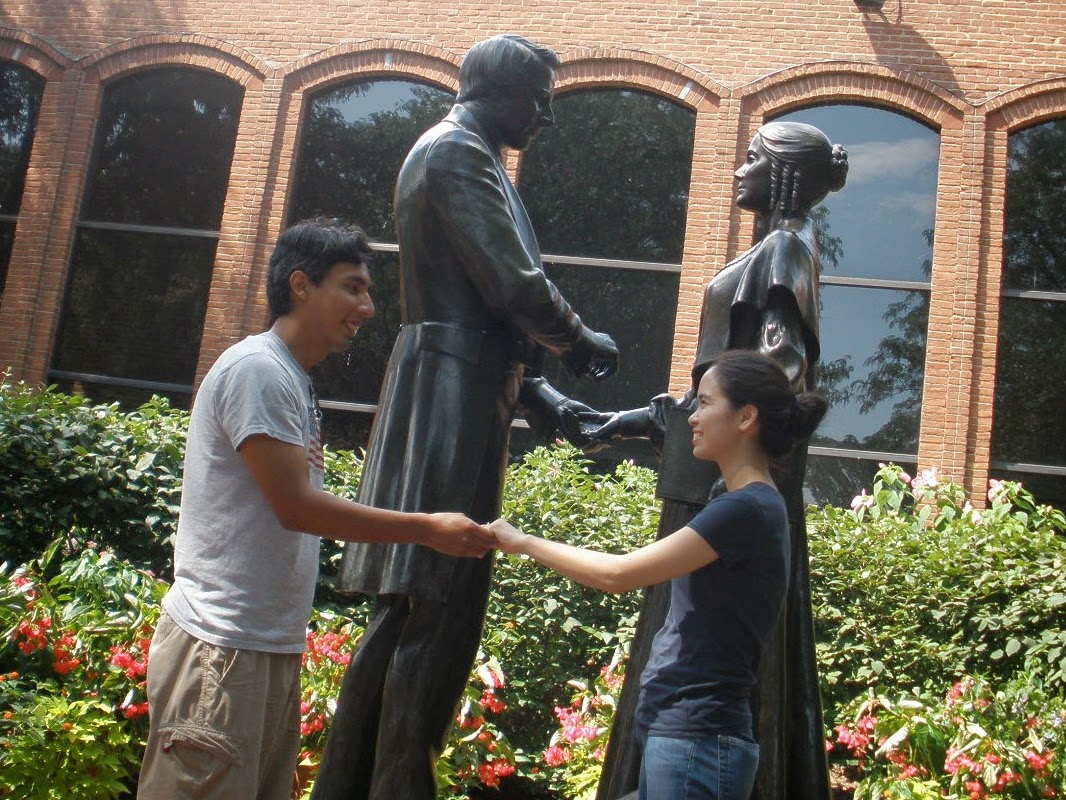
With hubby in Nauvoo

The second section, her father falls and hits his head and is rushed to the hospital.  As a nurse, I know what it’s like when someone hits their head, I know how they bleed, what the paramedics will ask, I even know what kinds of things a doctor will look for in that kind of an incident.

Both sections are familiar, and yet, it’s almost surreal writing because it’s not familiar to my MC.  She’s never been to Nauvoo, and she doesn’t know where each building is, how to get from one place to another.  She doesn’t know where the shows are, or which ones she needs tickets to.  And as an added difficulty, all of her travel companions speak Spanish, which she barely understands. 
With the paramedics and hospital, it’s not something that comes naturally to her.  This is her father, and she’s going to react on fear and probably not understand everything that’s going on.

I’ve never had to work so hard to think in someone else’s head.  In all of my other stories, I’m discovering the world with my characters.  They all live in foreign and exotic worlds, so I’m still trying to get an idea of the territory as I write.  But now, these are real world places and situations.  I have to be true to them, make sure that they are exactly right, and show them through the eyes of someone who’s not going to know what kind of assessments a doctor will do in an emergency room.  Or who doesn’t know the difference between Parley and Muholland Street.

Have you ever had to write about something you know well, but present it in a way that’s utterly foreign to you?


Wednesday, January 14, 2015

Query Party Update

The second week of our Query party is about to come to a close.  We’re already halfway through, which is absolutely amazing!  Thank you to everyone participating! (For those of you who didn't see the original post, the link is here)

I think the part that I’m really loving is the community that it’s creating.  I’m getting feedback from the different participants, and everything has been very positive.  There’s been questions about how queries work, questions about comments they’d received, and I’ve also had some share insights with others that have been fantastic!

The hard part about queries is trying to get an entire story into just one idea, make sure that it’s coherent and then try and sell it.  It’s not going to be written in one go.

I was talking to one of the participants about dealing with feedback.  Unfortunately, especially with queries, a lot of the feedback is going to be: I want to understand this, can you explain more?  And with the length constraints, it’s not going to be possible.  However, I’ve noticed that this kind of feedback is vital because it lets the writer know where they aren’t clear and need to explain.  Or, if they want to know more, that’s probably a good thing!  It means that their interest has been peaked.


So thank you to all that are participating, and for all of you interested, there’s still two weeks left!  Let me know if you want to jump in the last few rounds!